
CoLABOR 2024 Conference “Work, Vulnerabilities, and Social Security: Tools and Policies”
PRESS RELEASE
COLABOR CONFERENCE 2024: “Work, Vulnerabilities, and Social Security: Tools and Policies” – December 13, 2024
Labor relations, production processes, and labor market institutions in Portugal are undergoing a variety of changes, some of which are even moving in the opposite direction. The Portuguese economy is performing well in terms of wealth creation, job creation, and openness to the outside world. However, wealth creation is lower than in most European countries, and the labor market remains characterized by low wages, multiple forms of precariousness, and inequalities in resources and opportunities.
These trends take shape in accordance with specific institutional frameworks and regulatory frameworks. In this context, collective labor relations and the social security system fulfill important social, economic, and political functions. However, the social security system’s link to wages makes it dependent on employment profiles and career paths, thus making it vulnerable to the impacts of trends characterizing the labor market.
The complex reality described highlights a strong interdependence between work, employment, and social protection. In this context, the CoLABOR 2024 Conference presents a systematic overview of this interdependence and a set of new tools for integrated socioeconomic analysis, while also fostering an informed debate on the future of social security in our country.
CoLABOR is the only collaborative laboratory whose agenda focuses on the issues of work and employment and their connections to social protection systems, highlighting their central role as drivers of social and economic progress.
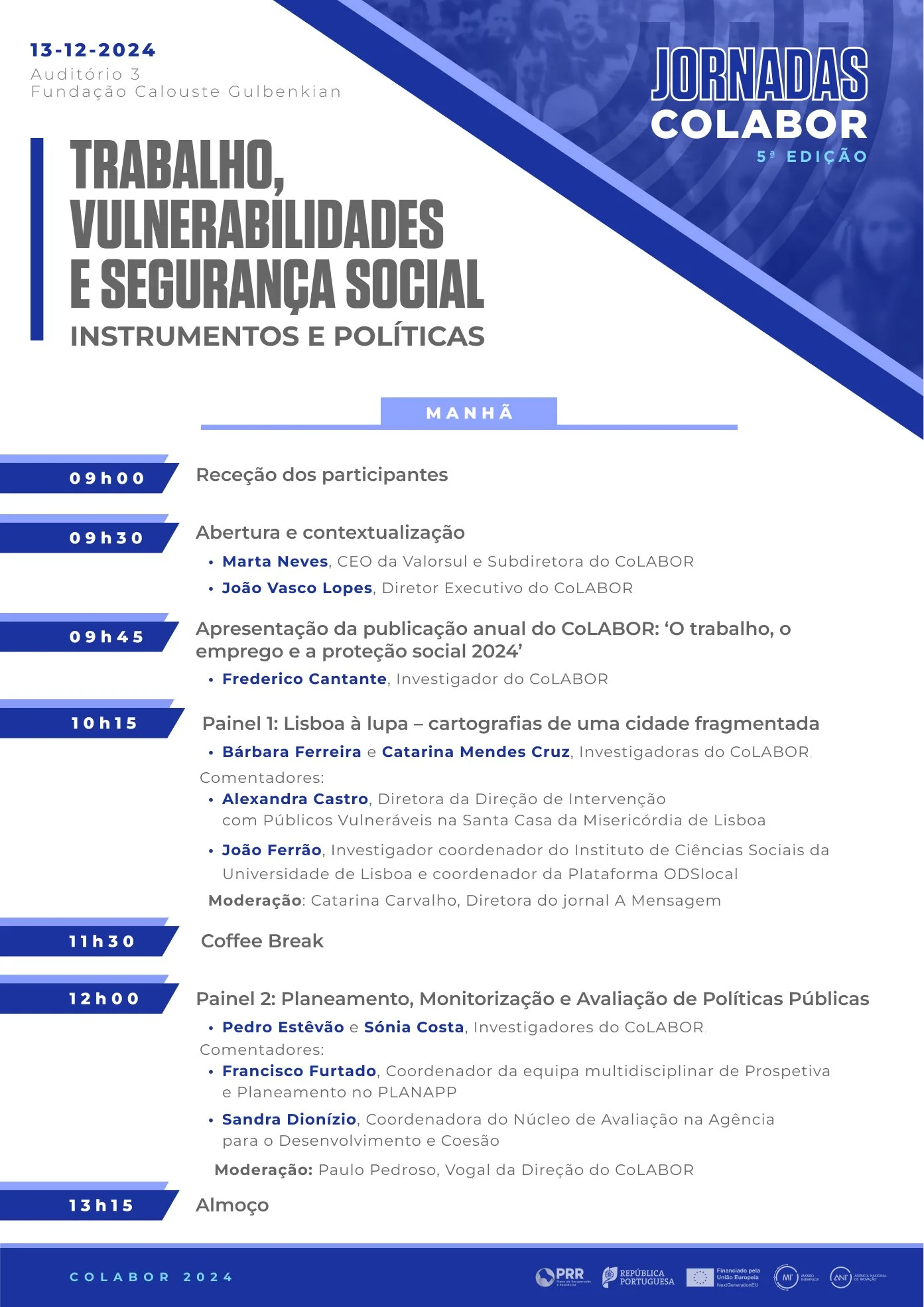
The CoLABOR 2024 Conference will take place on December 13 at the Calouste Gulbenkian Foundation in Lisbon, and this year’s theme is “Work, Vulnerabilities, and Social Security: Instruments and Policies.”
During the morning session, the activities carried out this year will be presented, the first edition of CoLABOR’s annual publication—titled *Work, Employment, and Social Protection in 2024*—will be launched, and the simulator will also be unveiled Salary Comparison simulator, which allows users to see where they stand in Portugal’s income distribution.
A complex socioeconomic reality calls for the development of integrated analytical tools. Later this morning, there will be two panels presenting projects and tools developed by CoLABOR. These panels will present the Social Portrait of Lisbon, a document based on the LxStat statistical data platform for the city of Lisbon; the Social Vulnerability Index (IVS) for the city of Lisbon; the Inequality Toolkit for evaluating public policies; and a project on the evaluability of training and education policies. Both sessions will feature commentary from experts in various fields.
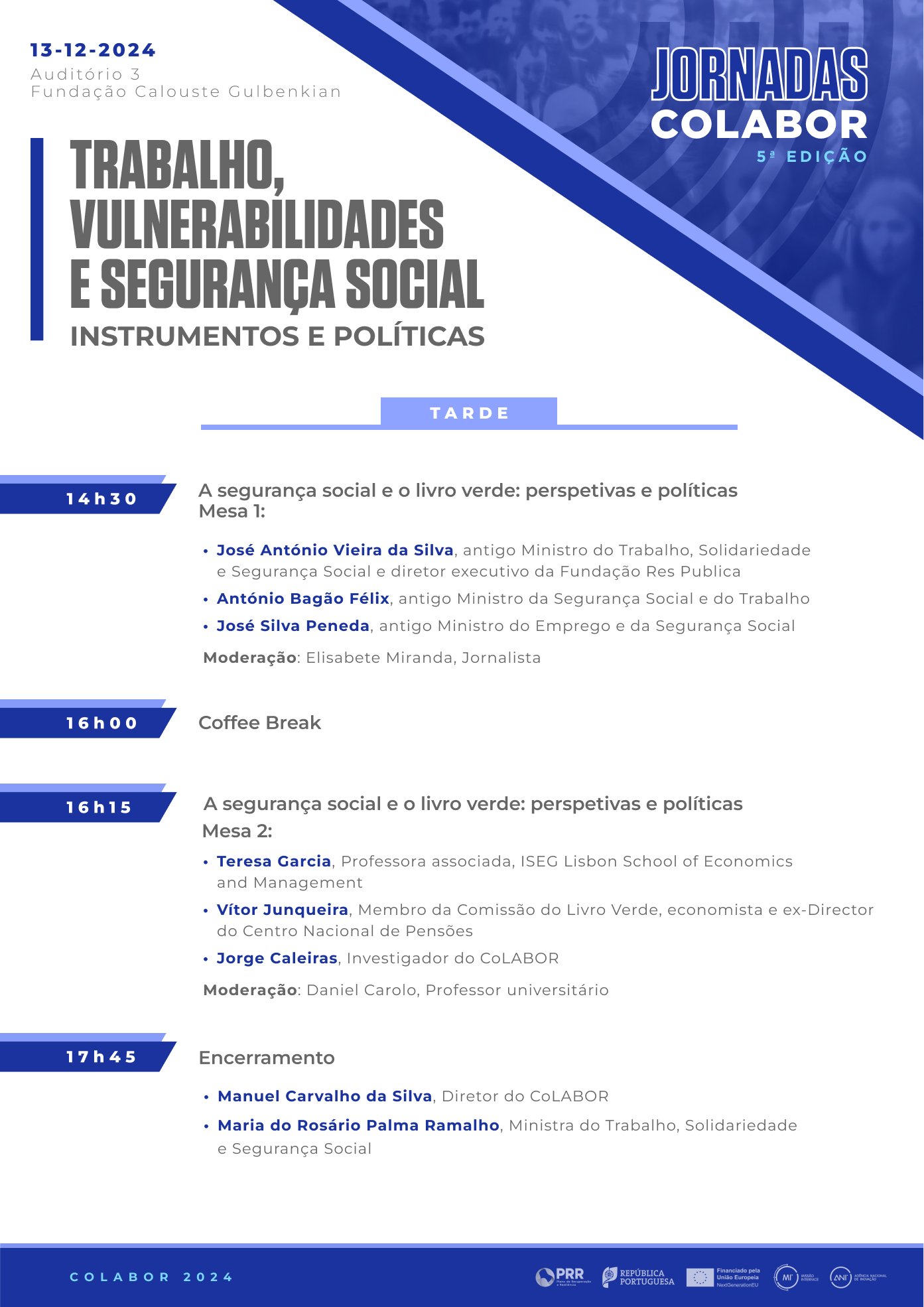
In the afternoon session, CoLABOR will host a discussion on the main issues raised by the Green Paper on the Sustainability of the Social Security System, drafted by the Commission for the Sustainability of Social Security and currently open for public comment until December 15. The debate is organized around two roundtables: the first featuring three former ministers of Social Security, and the second featuring qualified researchers from various academic disciplines.
The event will be closed by Manuel Carvalho da Silva, Director of CoLABOR, and by the Minister of Labor, Solidarity, and Social Security, Maria do Rosário Palma Ramalho.